



November/December 2026 Vintage Truck
/The November/December 2026 issue of the magazine is available in our gift shop now and will be available on newsstands soon. Thomas Wisener’s 1954 CJ-3B is the “middle child” postwar-era Jeep! Check out the cover story by B. Mitchell Carlson and Thomas Wisener, Photos by Al Rogers.
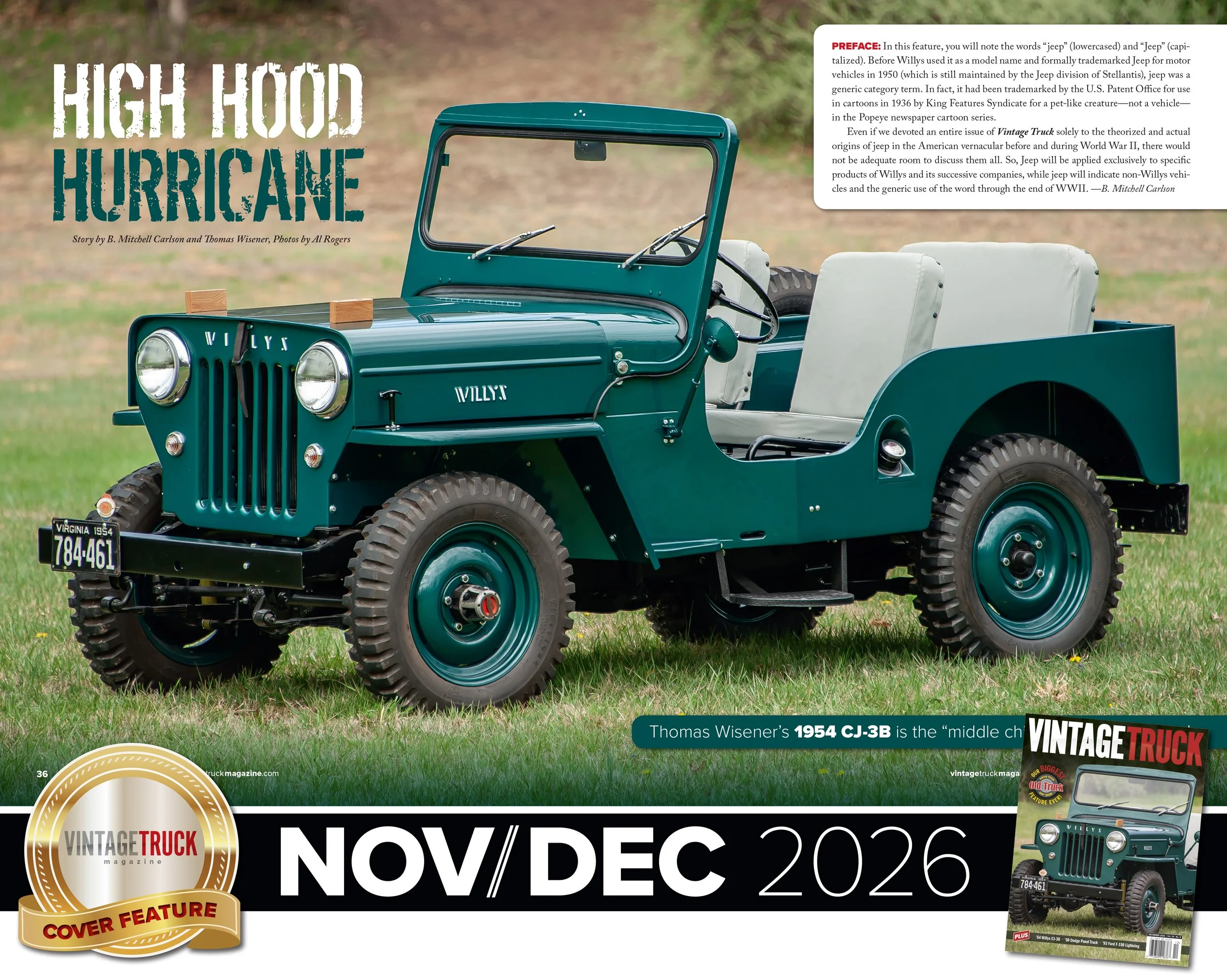
Cover Story | 1954 CJ-3B
High Hood Hurricane
Thomas Wisener’s 1954 CJ-3B is the “middle child” postwar-era Jeep!
Story by B. Mitchell Carlson and Thomas Wisener, Photos by Al Rogers
Preface: In this feature, you will note the words “jeep” (lowercased) and “Jeep” (capitalized). Before Willys used it as a model name and formally trademarked Jeep for motor vehicles in 1950 (which is still maintained by the Jeep division of Stellantis), jeep was a generic category term. In fact, it had been trademarked by the U.S. Patent Office for use in cartoons in 1936 by King Features Syndicate for a pet-like creature—not a vehicle—in the Popeye newspaper cartoon series.
Even if we devoted an entire issue of Vintage Truck solely to the theorized and actual origins of jeep in the American vernacular before and during World War II, there would not be adequate room to discuss them all. So, Jeep will be applied exclusively to specific products of Willys and its successive companies, while jeep will indicate non-Willys vehicles and the generic use of the word through the end of WWII. —B. Mitchell Carlson
Converting famous swords into profitable plowshares
Before WWII and the jeep, Willys-Overland had a varied product line—mostly smaller cars and trucks—that did not resonate with most of the American market (even though one of the car models was named “American”). During the war, the company saw the potentially vast civilian market for what was becoming the most iconic military vehicle of the conflict—the G503-series “1/4-ton, 4X4, Truck, Standard”—built by Willys as the Model MB and by Ford Motor Co. as the Model GPW. While Ford had no real interest in continuing a jeep product after completion of its war contracts (having “not invented here” and “we just want to get back to what we did before the war” mindsets at the time), Willys saw it as salvation.
The jeep gained instant name recognition among GIs and civilians alike as the little truck on the battlefield that just kept going. Beginning in 1943, with no civilian product to promote, Willys began an advertising campaign extolling the virtues of the model MBs it was building for the war effort, strongly linking the Willys name with the indestructible jeep.
After going through the U.S. Senate’s Truman Committee, which was overseen by then-Missouri Sen. Harry S. Truman to investigate military contractor fraud and waste, Willys managed to secure Jeep naming rights against a host of companies from Bantam to Minneapolis-Moline. Willys then went to work developing a civilian-attuned version between wartime projects.
We would love to get a copy of the November/December 2026 issue of Vintage Truck magazine in your hands! A wide variety of classics are waiting for you!
Articles in this issue include:
FEATURES
Drive Your Old Truck Day 2026
Stories by Vintage Truck readersGrandpa’s Fishing Truck
Kevin Perrine’s 1950 Dodge was bought new for personal use!
Story by Loren Hoekema, Photos by Brad BowlingHigh Hood Hurricane
Thomas Wisener’s 1954 CJ-3B is the “middle child” postwar-era Jeep!
Story by B. Mitchell Carlson and Thomas Wisener, Photos by Al RogersThe Modern Speed Truck
National Parts Depot’s 1993 Ford F-150 Lightning was a performance pickup pioneer!
Story by Robert Gabrick, Photos by Brad Bowling
Departments
Letter from the Editor
Letters to the Editor
Milestone Pickup Trucks: 1980 Ford 4X4s
Classifieds
Show Guide
Granny Gear: Study in White Plumes
Call 800-767-5828 or visit our Gift Shop to order current or back issues.
To subscribe, call 888-760-8108 or click here.


